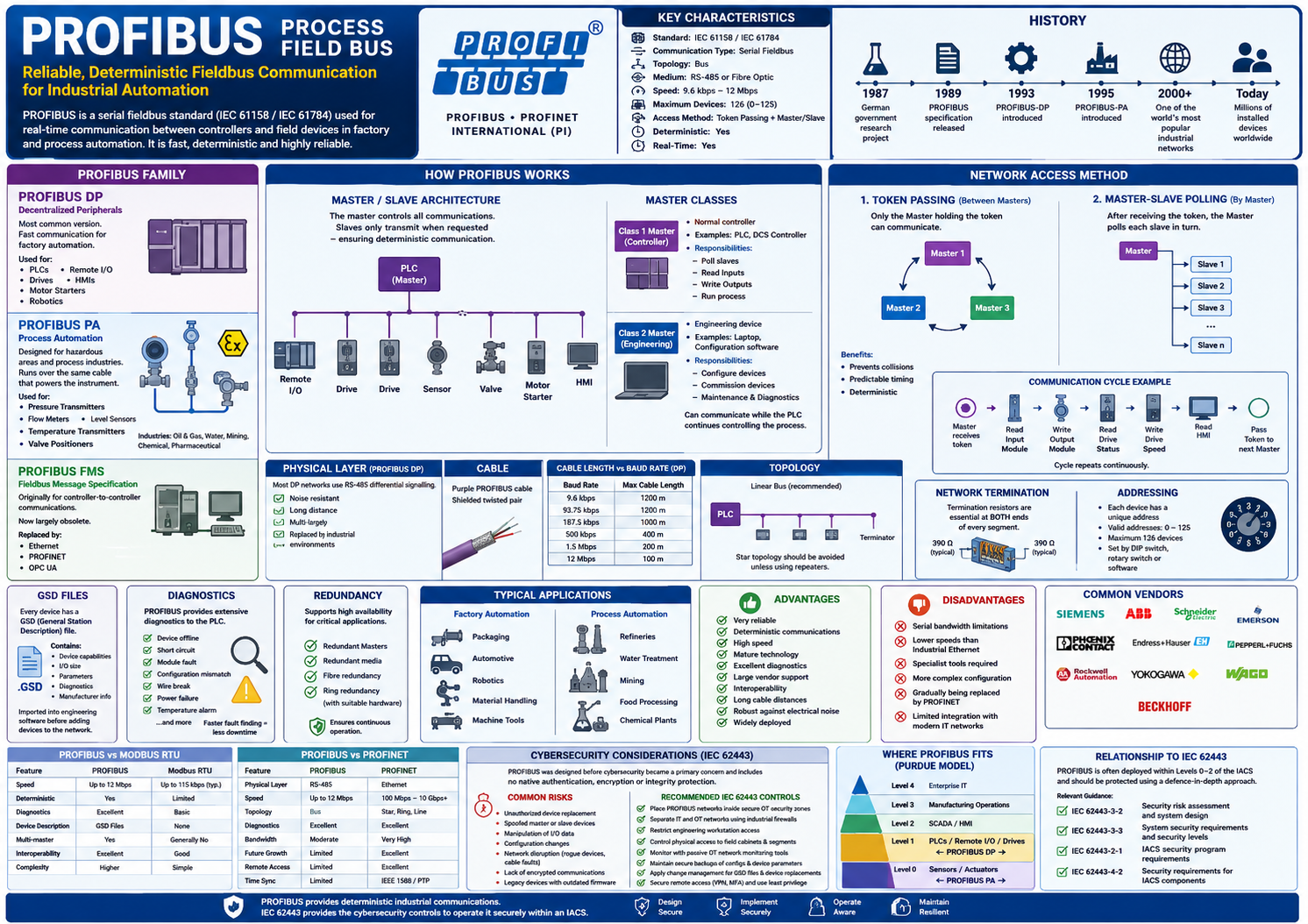
PROFIBUS (Process Field Bus) is one of the world's most widely used industrial fieldbus communication standards for factory automation and process automation. Developed in Germany during the late 1980s, it became an international standard and remains widely deployed despite the growth of Industrial Ethernet technologies.
PROFIBUS provides deterministic, reliable communications between PLCs, distributed I/O, drives, sensors, actuators, HMIs and process instrumentation.
Unlike Ethernet-based protocols, PROFIBUS is a dedicated fieldbus specifically designed for industrial environments requiring predictable communications and high reliability.
PROFIBUS is a serial fieldbus standard managed by PROFIBUS & PROFINET International (PI). It defines how industrial devices exchange cyclic process data, acyclic parameter data, and diagnostics over a shared bus network. The protocol is standardised under IEC 61158 and IEC 61784 and is implemented by millions of devices worldwide.
| Feature | Description |
|---|---|
| Standard | IEC 61158 / IEC 61784 |
| Communication Type | Serial Fieldbus |
| Topology | Bus |
| Medium | RS-485 or Fibre Optic |
| Speed | 9.6 kbps – 12 Mbps |
| Maximum Devices | 126 |
| Access Method | Token Passing + Master/Slave |
| Deterministic | Yes |
| Real-Time | Yes |
| Industrial Ethernet | No |
Managed by: PROFIBUS & PROFINET International (PI)
There are three main versions of PROFIBUS.
Decentralized Peripherals — the most common version.
Used for:
PROFIBUS DP provides fast communication and high speed, making it the primary choice for factory automation applications.
Process Automation — designed for hazardous areas and process industries.
Used for:
PROFIBUS PA runs over the same cable that powers the instrument and supports intrinsic safety. Common industries include oil & gas, water, mining, chemical, and pharmaceutical.
Fieldbus Message Specification — originally designed for controller-to-controller communications.
PROFIBUS FMS is now largely obsolete and has been replaced by Ethernet, PROFINET, and OPC UA.
PROFIBUS operates using a Master/Slave architecture. The master controls all communications; slave devices never transmit unless requested. This guarantees deterministic communication.
PLC (Master)

│

├── Remote I/O
├── Drive
├── Drive
├── Sensor
├── Valve
├── Motor Starter
└── HMI
Normal controller.
Examples:
Responsibilities:
Engineering device.
Examples:
Responsibilities:
A Class 2 master can communicate while the PLC continues controlling the process.
PROFIBUS combines two communication methods.
Used between masters.
Master 1

↓

Master 2

↓

Master 3

↓

Master 1
Only the master holding the token can communicate.
Benefits:
After receiving the token, the master polls every slave.
Master

↓

Slave 1

↓

Slave 2

↓

Slave 3
Each slave responds only when asked. No collisions occur.
Example cycle:
Master receives token

↓

Read Input Module

↓

Write Output Module

↓

Read Drive Status

↓

Write Drive Speed

↓

Read HMI

↓

Pass Token
The cycle repeats continuously.
PROFIBUS DP is optimised for speed. A typical scan cycle polls remote I/O, drives, servos, and valves in sequence, with update rates of a few milliseconds.
PLC

↓

Remote I/O

↓

Drive

↓

Servo

↓

Valve

↓

Repeat
PROFIBUS PA is slower than DP and prioritises reliability, long cable distances, hazardous locations, and device power. It is ideal for instrumentation in process industries.
Most PROFIBUS DP networks use RS-485.
Characteristics:
Cable: purple PROFIBUS cable — typically shielded twisted pair.
Maximum cable length depends on baud rate.
| Speed | Maximum Length |
|---|---|
| 9.6 kbps | 1200 m |
| 93.75 kbps | 1200 m |
| 187.5 kbps | 1000 m |
| 500 kbps | 400 m |
| 1.5 Mbps | 200 m |
| 12 Mbps | 100 m |
Repeaters extend distance.
PROFIBUS networks are usually configured as a linear bus.
PLC

|

Device

|

Device

|

Device

|

Terminator
Avoid star topology unless using repeaters.
Termination resistors are essential. Both ends of every segment require termination. Without termination, reflections, communication errors, and random faults can occur.
Each device has a unique address.
Valid addresses: 0 – 125
Maximum: 126 devices
Addresses are configured by:
Every PROFIBUS device has a GSD (General Station Description) file — equivalent to EDS files in DeviceNet.
Contains:
Engineering software imports GSD files before adding devices.
PROFIBUS provides excellent diagnostics. Examples include:
Diagnostic information is available directly to the PLC.
PROFIBUS can support:
Often used in critical plants.
| Feature | PROFIBUS | Modbus RTU |
|---|---|---|
| Speed | Up to 12 Mbps | Up to 115 kbps (typically) |
| Deterministic | Yes | Limited |
| Diagnostics | Excellent | Basic |
| Device Description | GSD Files | None |
| Multi-master | Yes | Generally No |
| Vendor Interoperability | Excellent | Good |
| Complexity | Higher | Simple |
| Feature | PROFIBUS | PROFINET |
|---|---|---|
| Physical Layer | RS-485 | Ethernet |
| Speed | 12 Mbps | 100 Mbps–10 Gbps+ |
| Topology | Bus | Star, Ring, Line |
| Diagnostics | Excellent | Excellent |
| Bandwidth | Moderate | Very High |
| Future Growth | Limited | Excellent |
| Remote Access | Limited | Excellent |
| Time Sync | Limited | IEEE 1588/PTP |
PROFIBUS was designed before cybersecurity became a primary concern and therefore includes no native authentication, encryption, or integrity protection. Devices typically trust all valid protocol traffic, making network architecture and compensating controls essential.
Level 4  Enterprise IT
──────────────────────────

Level 3  Manufacturing Operations
──────────────────────────

Level 2  SCADA / HMI
──────────────────────────

Level 1  PLCs / Remote I/O / Drives
       ← PROFIBUS DP →

──────────────────────────

Level 0  Sensors / Actuators
       ← PROFIBUS PA →
PROFIBUS is frequently deployed within Levels 0–2 of the industrial control system and should be protected using a defence-in-depth approach as described in IEC 62443.
Relevant guidance includes:
PROFIBUS itself provides deterministic industrial communications, while IEC 62443 defines the cybersecurity controls required to operate those communications securely within an Industrial Automation and Control System (IACS).