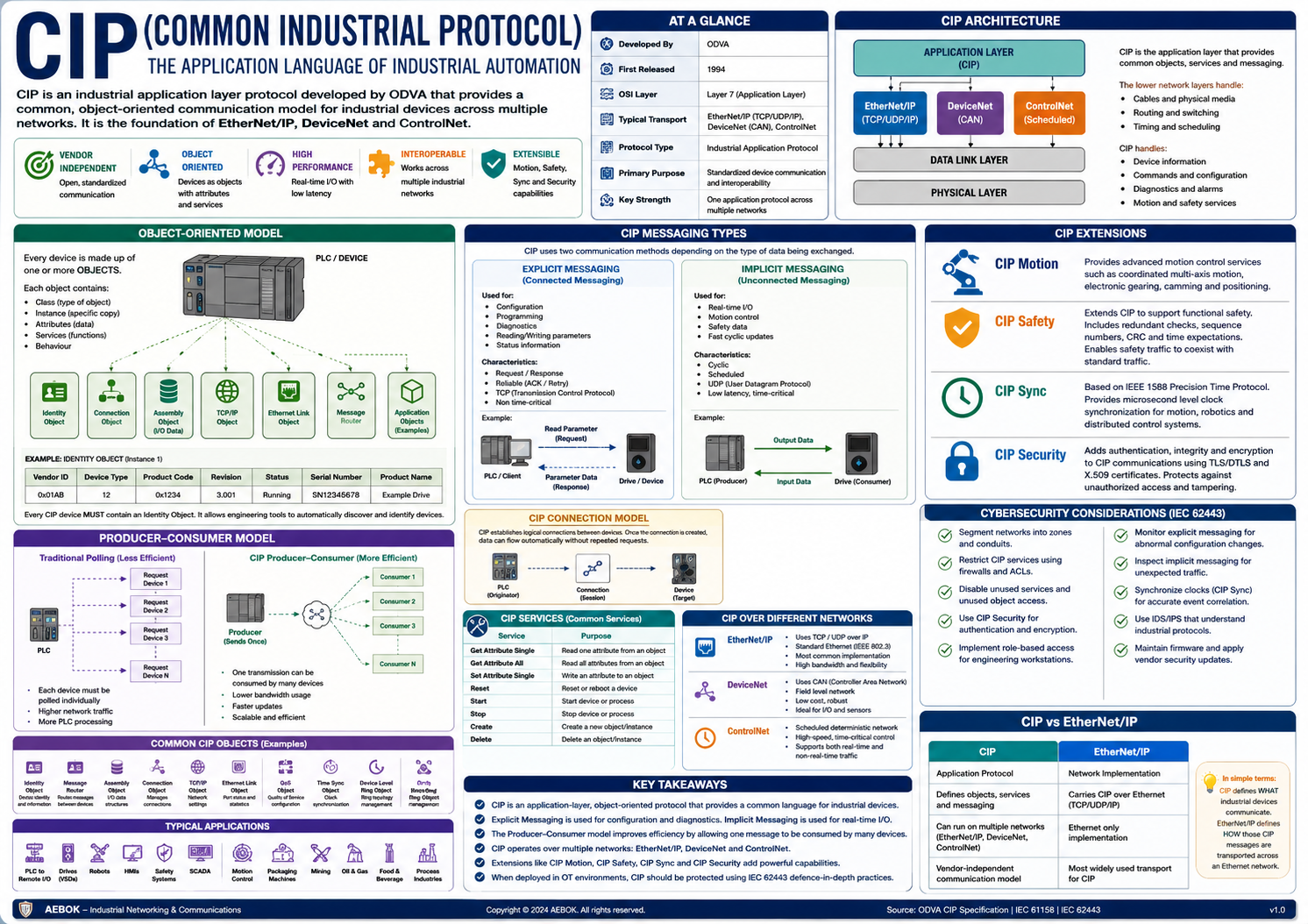
The Common Industrial Protocol (CIP) is an industrial application-layer protocol developed by
ODVA that provides a common, object-oriented communication model for industrial
automation devices. Unlike register-based protocols such as Modbus, CIP represents every device as a collection
of objects, each containing attributes, services, and behaviours. CIP is the foundation of
EtherNet/IP, DeviceNet, and ControlNet, allowing vendors to
support multiple industrial networks without redesigning the application protocol.
Figure – How CIP provides a common application protocol across EtherNet/IP, DeviceNet, and ControlNet.
Overview
The Common Industrial Protocol (CIP) is an industrial application protocol developed by ODVA that
provides a common object-oriented communication model for industrial automation devices.
Unlike protocols such as Modbus, which simply read and write registers, CIP represents every device as a collection
of objects, each containing attributes, services, and behaviours.
One of CIP's biggest advantages is that the same application protocol works across multiple physical
networks, allowing different network technologies to communicate using identical services.
CIP is the foundation of:
EtherNet/IP
DeviceNet
ControlNet
CompoNet (legacy)
This allows vendors to support multiple industrial networks without redesigning the application protocol.
Why CIP Was Developed
Prior to CIP:
Vendors created proprietary protocols.
Different networks required different software.
Devices were difficult to integrate.
Limited interoperability existed.
CIP solved these issues by defining:
Common device models
Standard services
Standard object classes
Common messaging methods
As a result, PLCs, drives, sensors, robots, HMIs, and safety devices from different manufacturers can communicate
consistently.
Allows safety traffic and standard traffic to coexist on the same network while remaining logically separated.
Applications include:
Emergency stops
Safety PLCs
Safety drives
Safety I/O
CIP Sync
CIP Sync is based on the Precision Time Protocol.
Provides:
Microsecond clock synchronization
Motion coordination
Distributed clocks
Timestamp accuracy
Required for:
Motion control
Robotics
High-speed automation
CIP Security
CIP Security enhances communications by adding:
Authentication
Device identity verification
Encryption
Confidentiality
Integrity protection
Secure session establishment
Typically implemented using:
Transport Layer Security for TCP communications
Datagram Transport Layer Security for UDP communications
Certificate-based authentication using X.509 certificates
Benefits:
Prevents unauthorized devices joining the network
Protects against message tampering
Encrypts sensitive industrial communications
Supports secure remote access
Advantages
Vendor independent
Object-oriented architecture
Supports multiple physical networks
Excellent interoperability
High-speed cyclic communications
Real-time I/O
Motion support
Functional safety support
Time synchronization
Strong diagnostics
Scalable
Widely adopted in industrial automation
Limitations
More complex than Modbus
Object model has a steeper learning curve
Larger protocol overhead
Configuration can be more involved
Requires a solid understanding of connections and objects for troubleshooting
Relationship to EtherNet/IP
A common misconception is that CIP and EtherNet/IP are the same protocol.
CIP
EtherNet/IP
Application protocol
Network implementation
Defines objects, services and messaging
Carries CIP over standard Ethernet/TCP/UDP/IP
Can run on multiple networks
Ethernet-only implementation
Vendor-independent communication model
Most widely used transport for CIP
In simple terms: CIP defines what industrial devices communicate, while EtherNet/IP
defines how those CIP messages are transported across an Ethernet network.
Cybersecurity Considerations (IEC 62443)
CIP networks should be secured using a defence-in-depth strategy aligned with the principles of IEC 62443.
Key recommendations include:
Segment industrial networks into security zones and conduits.
Restrict CIP services using industrial firewalls and access control lists.
Disable unused services and unnecessary object access.
Use CIP Security where supported for authentication and encryption.
Implement role-based access control for engineering workstations.
Monitor explicit messaging for abnormal configuration changes.
Inspect implicit messaging for unexpected traffic rates or destinations.
Synchronise clocks (for example using CIP Sync) to support accurate event correlation.
Continuously monitor networks with intrusion detection systems that understand industrial protocols.
Maintain firmware and apply vendor security updates through a controlled change management process.
Typical Applications
PLC to Remote I/O
PLC to Variable Speed Drives (VSDs)
PLC to Robots
PLC to Safety Controllers
PLC to HMIs
PLC to SCADA
Motion Control Systems
Packaging Machines
Automotive Manufacturing
Food & Beverage Plants
Mining Automation
Oil & Gas Facilities
Process Industries
Key Takeaways
CIP is an application-layer industrial protocol that provides a common communication model across multiple industrial networks.
It uses an object-oriented architecture with standardised classes, instances, attributes, and services.
Two messaging types are used: Explicit Messaging for configuration and diagnostics, and Implicit Messaging for high-speed real-time I/O.
The Producer-Consumer model improves efficiency by allowing one transmission to be consumed by multiple devices.
EtherNet/IP is the most common transport for CIP, but the protocol also operates over DeviceNet and ControlNet.
Extensions such as CIP Motion, CIP Safety, CIP Sync, and CIP Security add advanced capabilities for modern industrial automation.
When deployed in OT environments, CIP should be protected using the layered security practices defined by IEC 62443 to reduce cyber risk and improve operational resilience.