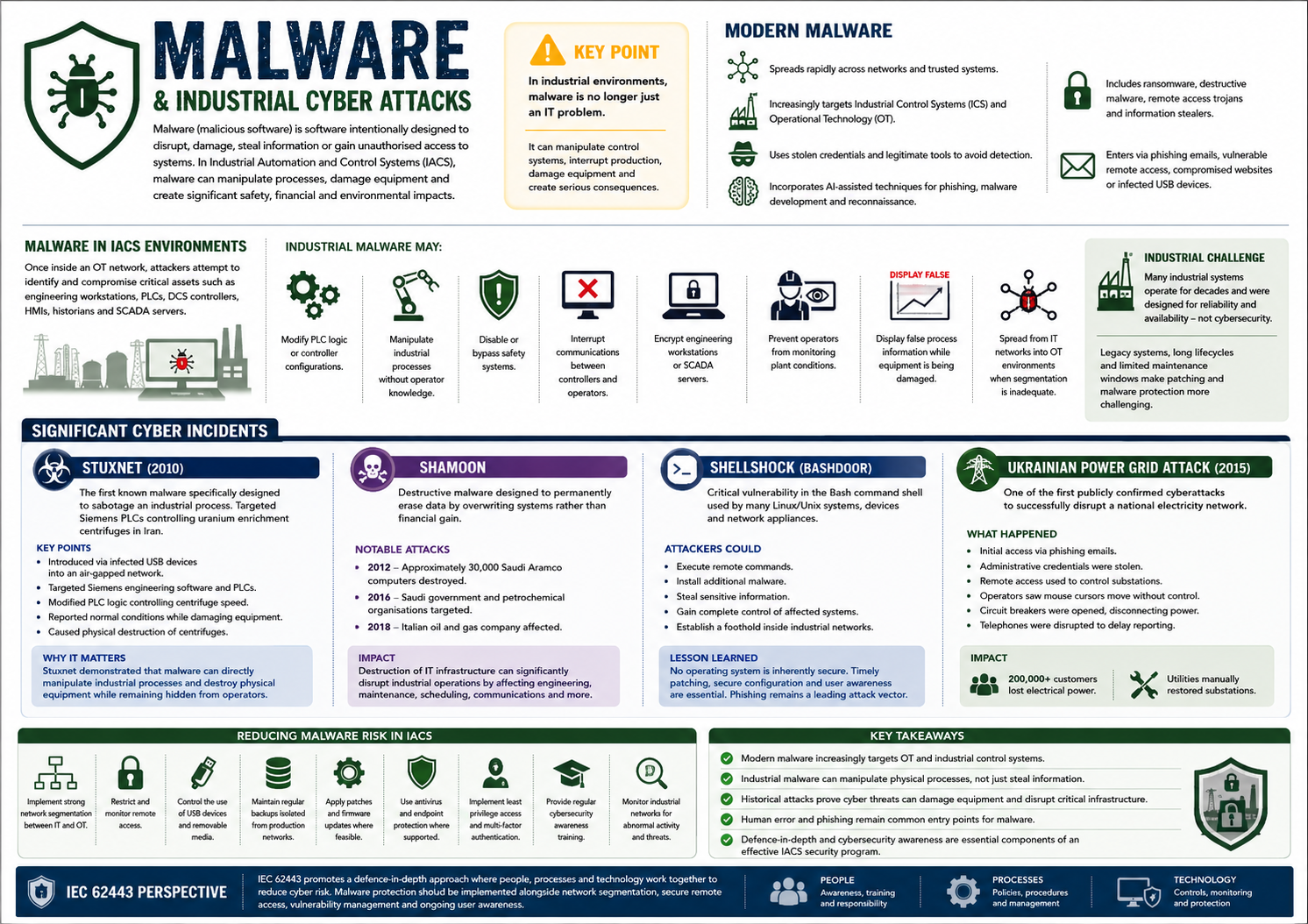
Malware & Industrial Cyber Attacks
Malware (malicious software) is software intentionally designed to disrupt, damage,
steal information or gain unauthorised access to computer systems. While malware has
traditionally targeted business IT systems, modern malware increasingly targets
Industrial Automation and Control Systems (IACS), where successful attacks can directly
affect safety, production, equipment reliability and critical infrastructure.
Key Point
In industrial environments, malware is no longer just an IT problem. It can manipulate
control systems, interrupt production, damage equipment and create significant safety,
financial and environmental consequences.
Modern Malware
Today's malware is far more sophisticated than early computer viruses. Modern attacks are
often developed by organised cybercriminal groups or nation-state actors and are designed
to remain undetected while moving through networks until valuable systems are reached.
- Rapidly spreads across connected networks and trusted systems.
- Increasingly targets Industrial Control Systems (ICS) and Operational Technology (OT).
- Uses stolen credentials and legitimate administration tools to avoid detection.
- Frequently incorporates AI-assisted techniques to improve phishing and reconnaissance.
- Includes ransomware, destructive malware, remote access trojans and information stealers.
- Often enters organisations through phishing emails, vulnerable remote access services, compromised websites or infected USB devices.
Malware in Industrial Automation & Control Systems (IACS)
Malware targeting industrial environments differs from traditional IT malware because its
objective is often to disrupt or manipulate physical processes rather than simply steal
information. Once inside an OT network, attackers commonly attempt to identify engineering
workstations, PLCs, DCS controllers, HMIs, historians and SCADA servers.
Industrial malware may:
- Modify PLC logic or controller configurations.
- Manipulate industrial processes without operator knowledge.
- Disable or bypass safety systems.
- Interrupt communications between controllers and operator workstations.
- Encrypt engineering workstations or SCADA servers using ransomware.
- Prevent operators from monitoring plant conditions.
- Display false process information while equipment is being damaged.
- Spread from corporate IT networks into operational technology environments where network segmentation is inadequate.
Industrial Challenge
Many industrial systems operate for decades and were originally designed with reliability
and availability as the primary objectives. Legacy equipment, limited maintenance windows
and compatibility requirements can make patching and malware protection significantly more
challenging than in traditional IT environments.
Significant Cyber Incidents
Stuxnet (2010)
Stuxnet was the first publicly known malware specifically engineered to sabotage an
industrial process. It targeted Siemens PLCs controlling uranium enrichment centrifuges
within Iranian nuclear facilities.
Key Characteristics
- Introduced into an air-gapped network using infected USB devices.
- Targeted Siemens engineering software and PLCs.
- Modified PLC logic controlling centrifuge speed.
- Reported normal operating conditions to operators while damaging equipment.
- Caused the physical destruction of centrifuges through process manipulation.
Why It Was Significant
Stuxnet demonstrated that malware could directly manipulate industrial processes,
destroy physical equipment and remain hidden from operators. It fundamentally changed
how industrial cybersecurity is approached worldwide.
Shamoon
Shamoon is destructive malware designed to permanently erase computer systems rather
than generate financial gain. Instead of encrypting files like ransomware, it overwrites
data, rendering affected computers unusable.
Major Incidents
- 2012 – Approximately 30,000 Saudi Aramco computers destroyed.
- 2016 – Saudi government and petrochemical organisations targeted.
- 2018 – Italian oil and gas company affected.
Although Shamoon primarily targeted business IT systems, destruction of corporate
infrastructure can significantly disrupt industrial operations by affecting engineering,
maintenance, scheduling, documentation and communications.
Shellshock (Bashdoor)
Shellshock was a critical vulnerability affecting the Bash command shell used by many
Linux and Unix operating systems. Numerous industrial servers, embedded devices and
network appliances were vulnerable.
Potential Impact
- Execute remote commands without authorisation.
- Install additional malware.
- Steal sensitive information.
- Gain complete control of affected systems.
- Provide attackers with a foothold inside industrial networks.
Lesson Learned
No operating system is inherently secure. Effective cybersecurity depends upon timely
patching, secure configuration, vulnerability management and user awareness. Human
factors such as phishing remain one of the most common methods attackers use to gain
initial access.
Ukrainian Power Grid Attack (2015)
The Ukrainian Power Grid attack was one of the first publicly confirmed cyberattacks
to successfully disrupt a national electricity network. Attackers spent months gaining
access, stealing credentials and learning operational procedures before executing the attack.
Attack Timeline
- Initial access obtained through phishing emails.
- Administrative credentials were stolen.
- Remote access was used to control electrical substations.
- Operators watched mouse cursors move without their control.
- Circuit breakers were remotely opened, disconnecting electricity supplies.
- Telephone systems were simultaneously disrupted to delay customer reporting.
Impact
- Over 200,000 customers lost electrical power.
- Utilities were forced to manually restore substations.
- Demonstrated that cyberattacks can successfully disrupt critical national infrastructure.
Industrial Cybersecurity Lesson
Major cyber incidents are rarely caused by a single vulnerability. They typically involve
phishing, credential theft, inadequate network segmentation, misuse of remote access,
insufficient monitoring and poor security practices occurring together.
Reducing Malware Risk in IACS
No single control can completely prevent malware. Industrial cybersecurity relies upon
multiple layers of defence working together to reduce the likelihood and impact of an attack.
- Implement strong network segmentation between IT and OT environments.
- Restrict and monitor remote access into industrial networks.
- Control the use of USB devices and removable media.
- Maintain regular backups that are isolated from production networks.
- Apply security patches and firmware updates where operationally feasible.
- Use antivirus and endpoint protection where supported.
- Implement least privilege and multi-factor authentication.
- Provide regular cybersecurity awareness training for all personnel.
- Monitor industrial networks for abnormal activity and indicators of compromise.
IEC 62443 Perspective
IEC 62443 promotes a defence-in-depth approach where people, processes and technology work
together to reduce cyber risk. Malware protection should be implemented alongside network
segmentation, secure remote access, vulnerability management and ongoing user awareness.
Key Takeaways
- Modern malware increasingly targets Operational Technology and Industrial Control Systems.
- Industrial malware can manipulate physical processes, not just steal information.
- Historical attacks demonstrate that cyber incidents can damage equipment and disrupt critical infrastructure.
- Human error and phishing remain common entry points for malware.
- Defence-in-depth and cybersecurity awareness are essential components of an effective IACS security program.