Cyber Security Awareness
People are one of the strongest layers of defence within Industrial Automation and Control Systems (IACS). Effective awareness programs reduce cyber risk by improving security behaviours across the organisation.
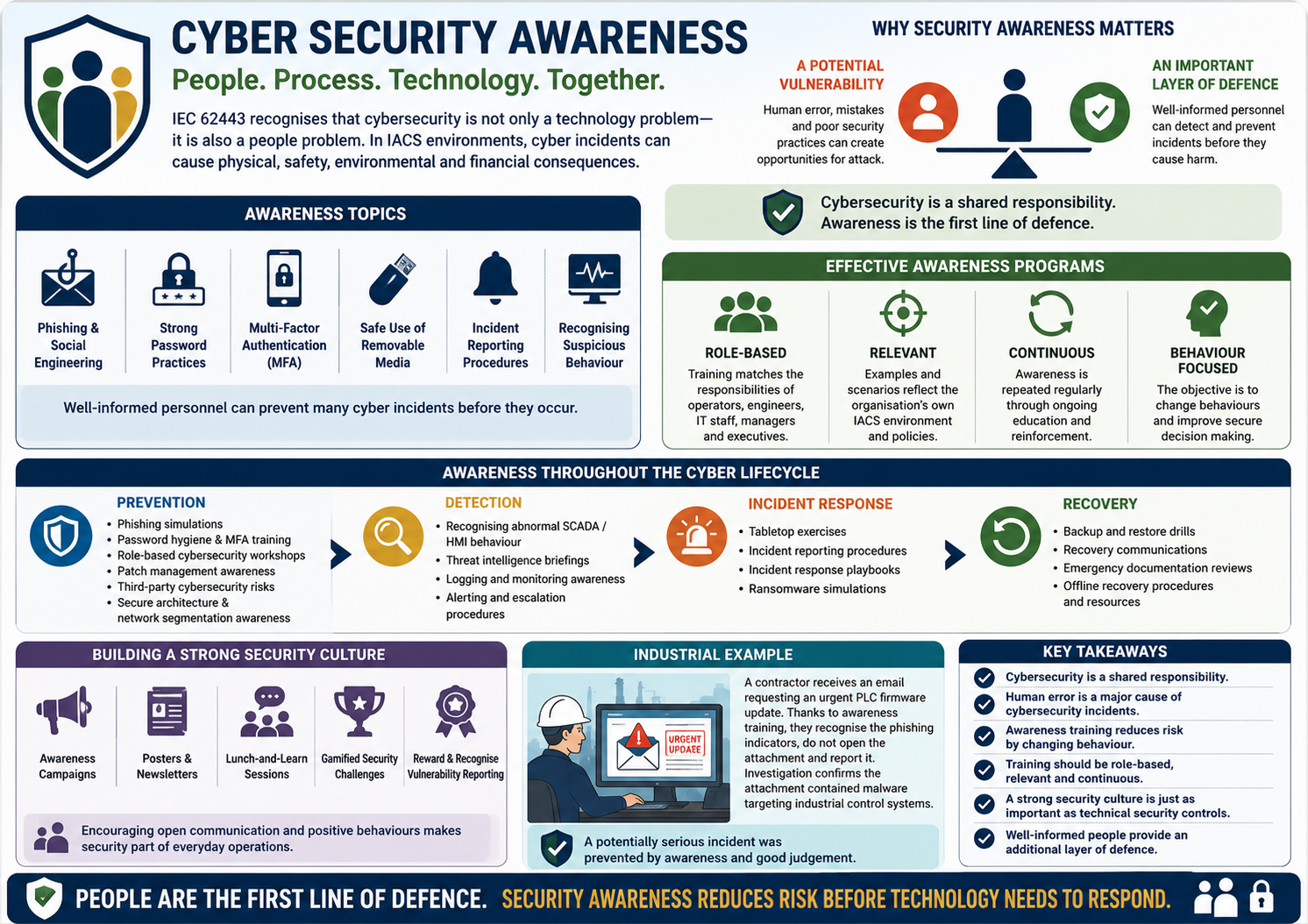
Why Security Awareness Matters
IEC 62443 recognises that cybersecurity is not solely a technology problem—it is equally a people problem. Many successful cyber attacks exploit human behaviour rather than technical weaknesses.
Within Industrial Automation and Control Systems (IACS), cyber incidents can have consequences extending well beyond the loss of data. Compromised systems may disrupt production, damage equipment, create environmental incidents or introduce serious safety hazards for personnel.
For this reason, cybersecurity should receive the same level of organisational attention as safety, operational integrity and reliability.
People are Both...
- A potential vulnerability through mistakes or poor security practices.
- An important layer of defence capable of identifying and preventing cyber incidents.
Well-informed personnel frequently detect suspicious activity long before automated security systems, making awareness one of the most valuable security investments an organisation can make.
Awareness as a Cybersecurity Countermeasure
Security awareness is one of the most effective and lowest-cost cybersecurity controls available. Educating personnel significantly reduces the likelihood of incidents caused by human error, which remains one of the leading causes of successful cyber attacks.
Common awareness topics include:
- Recognising phishing emails and social engineering attacks
- Strong password creation and password management
- Using Multi-Factor Authentication (MFA)
- Safe handling of USB devices and removable media
- Incident reporting procedures
- Recognising unusual SCADA, HMI or control system behaviour
- Following organisational cybersecurity policies and procedures
Awareness is the first line of defence. Many cyber attacks can be prevented simply by making informed security decisions before clicking, connecting or responding.
Characteristics of Effective Awareness Programs
IEC 62443 recommends that awareness programs become part of normal business operations rather than occasional compliance activities.
| Principle | Description |
|---|---|
| Role-Based | Training should match the responsibilities of operators, engineers, maintenance personnel, IT staff, managers and executives. |
| Relevant | Training should use examples, incidents and scenarios that reflect the organisation's own IACS environment. |
| Continuous | Awareness should be reinforced regularly through ongoing education rather than one-off training sessions. |
| Behaviour Focused | The objective is to improve secure behaviours and decision making, not simply deliver information. |
Examples of Awareness Activities
Prevention
- Phishing simulations
- Password hygiene and MFA training
- Role-based cybersecurity workshops
- Patch management awareness
- Third-party cybersecurity risk awareness
- Secure architecture and network segmentation awareness
Detection
- Recognising abnormal SCADA or HMI behaviour
- Threat intelligence briefings
- Logging and monitoring awareness
- Alerting and escalation procedures
Incident Response
- Tabletop exercises
- Incident reporting procedures
- Incident response playbooks
- Ransomware simulations
Recovery
- Backup and restore drills
- Recovery communication exercises
- Emergency documentation reviews
- Offline recovery procedures and resources
Building a Strong Security Culture
Effective cybersecurity awareness extends beyond formal training. Organisations should encourage security to become part of everyday operations by promoting positive behaviours and open communication.
Examples include:
- Organisation-wide awareness campaigns
- Cybersecurity posters and newsletters
- Lunch-and-learn presentations
- Gamified cybersecurity challenges
- Rewarding responsible vulnerability reporting
- Sharing lessons learned from real cyber incidents
Developing a positive security culture encourages personnel to identify and report potential issues without fear of blame, allowing organisations to respond more quickly to emerging threats.
Industrial Example
A maintenance contractor receives an email requesting an urgent PLC firmware update with an attached executable file. Because the contractor has completed cybersecurity awareness training, they recognise several phishing indicators, avoid opening the attachment and report the email to the cybersecurity team. Investigation confirms the attachment contained malware targeting industrial control systems.
A potentially serious cyber incident is prevented through awareness rather than technical controls alone.
Key Takeaways
- Cybersecurity is a shared responsibility across the organisation.
- Human error remains one of the leading causes of cybersecurity incidents.
- Awareness training reduces cyber risk by improving security behaviours.
- Training should be role-based, relevant, practical and continuous.
- Strong security culture complements technical cybersecurity controls.
- Well-informed personnel provide an additional layer of defence for IACS environments.